Last updated October 15, 2026
How to Hire a ADU Contractor in Ventura: A Step-by-Step Guide
In 2023, Ventura County logged 47 contractor-related complaints with the California Contractors State License Board involving residential additions and accessory dwelling units. The pattern repeats year after year: homeowners signed with the lowest bidder before verifying the license was active, before confirming subcontractors were covered by insurance, and before understanding what the written agreement actually obligated either party to do. This guide walks through the hiring sequence that protects you from that outcome, step by step, with the specific documents to request and the specific red flags to recognize before you ever discuss price, or browse our more guides & resources for additional homeowner support.
Quick Answer
To hire an ADU contractor in Ventura, verify the license is active on CSLB.ca.gov, request four documents before any in-person meeting (license number, insurance certificate naming you as additional insured, a list of completed Ventura ADU projects, and two recent permit records), then compare written bids using the allowance audit method. Never sign with a contractor who asks for more than 10% down before work starts, which is illegal in California, or who cannot explain in writing who will pull permits and handle inspections.
Table of Contents
- Step 1: Verify the License on CSLB.ca.gov (Under 3 Minutes)
- Step 2: Request the Four Documents Before the First Meeting
- Step 3: What a Legitimate Written Bid Covers vs. a One-Page Estimate
- Step 4: Red Flags Specific to ADU Contractors
- Step 5: How to Compare Bids $40,000 Apart: The Allowance Audit
- Step 6: Permits, Inspections, and Ventura-Specific Requirements
- Step 7: Payment Schedules That Protect You
- Step 8: Working with Prefab ADU Brands in Ventura
- Common Mistakes to Avoid
- When to Call a Professional
- Frequently Asked Questions
- The Bottom Line
Step 1: Verify the License on CSLB.ca.gov (Under 3 Minutes)
California makes license verification fast and free, yet most homeowners skip it entirely. The process takes under three minutes and tells you three critical things: whether the license is active, suspended, or expired; how long the contractor has held it; and whether any citations or disciplinary actions appear on the record. An active license means the contractor has met California’s bonding and insurance requirements and passed the trade exam. A suspended license typically signals a lapse in bond coverage, unresolved citations, or unpaid judgments. An expired license means the contractor cannot legally perform work in Ventura or anywhere else in California.
Here’s the three-minute check:
- Go to CSLB.ca.gov and click “Check a License.”
- Enter the contractor’s name or license number. The record shows the classification (ADU work falls under General Building Contractor, Class B) and the license status.
- Check the “Bonding” and “Insurance” fields. If the bond shows “Cancelled” or the insurance shows “Not on file,” do not proceed with that contractor, regardless of the bid.
- Look at the “Workers’ Compensation” section. If it lists exemptions but the contractor has employees or subs, walk away. Uncovered workers on your property create liability for you.
In Ventura, we see homeowners who hired contractors with expired licenses and then discovered the work performed was uninsurable, meaning their homeowners policy would not cover defects or damage related to the project. Verifying the license is not a formality. It is the difference between a contractor the state stands behind and one the state has effectively disowned. At Lodgewick ADU Ventura home, every written bid includes our license number printed right on the front page, because a contractor who hesitates to share it is answering your first question.
Step 2: Request the Four Documents Before the First Meeting
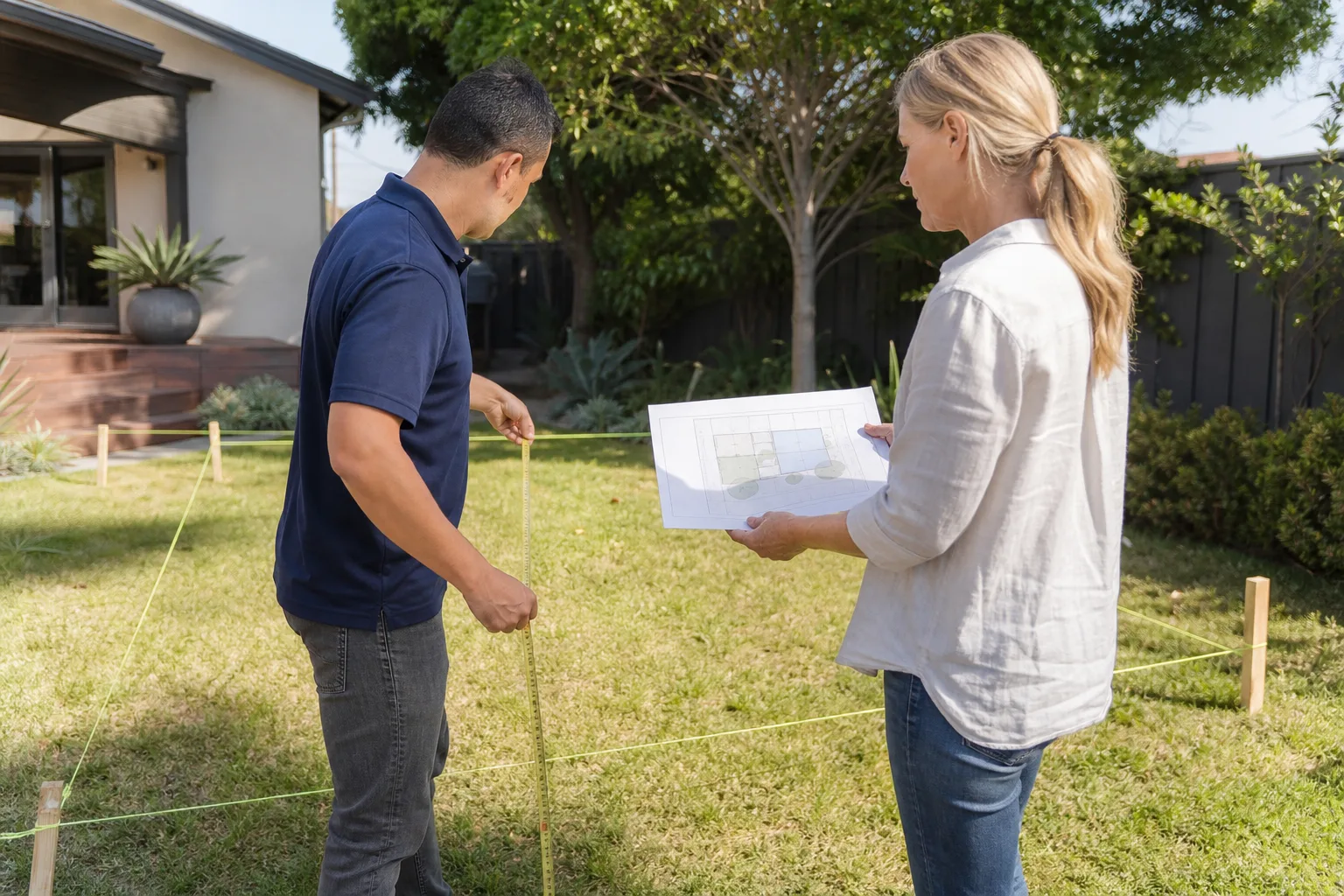
Before you let any contractor step onto your Ventura property for a site visit, request four documents. Legitimate contractors will send them the same day. Contractors who stall, make excuses, or claim the documents are “in the office” are telling you something useful about how the rest of the project will go. The documents are:
- License number: As covered in Step 1, this gets verified on CSLB.ca.gov before anything else happens.
- Certificate of insurance naming you as additional insured: This is not the same as the contractor simply having insurance. “Additional insured” means their policy extends protection to you if a claim arises from work on your property. Without it, you are relying on their insurer to voluntarily cover you. Request the certificate directly from the insurance carrier, not a photocopy from the contractor.
- A list of Ventura-area ADU projects completed: Specifically ask for addresses or at least neighborhoods (Midtown, East Ventura, College Area, Pierpont, or beyond into Camarillo and Oxnard). Then ask for the permit numbers associated with those projects. A contractor who has built three ADUs in Ventura but cannot produce a single permit number is describing unpermitted work, which creates problems for you years later when you sell or refinance.
- At least two pull-able permit records: “Pull-able” means you can look them up yourself through the Ventura County Building and Safety division. The contractor should provide the permit number, the address, and the date of final inspection. If the final inspection is missing, ask why. Unclosed permits are a lien waiting to happen.
Russ Delmar, owner at Lodgewick ADU Ventura, keeps a folder of permit records ready for exactly this request. “When a homeowner asks for permit history, they’re doing their job,” he says. “When a contractor can’t produce it, nobody did theirs.” We treat this document request as a baseline test, and we recommend every Ventura homeowner do the same. If you’re weighing a larger project, our Home Addition Contractor in Ventura page covers the additional documentation home additions require.
Step 3: What a Legitimate Written Bid Covers vs. a One-Page Estimate
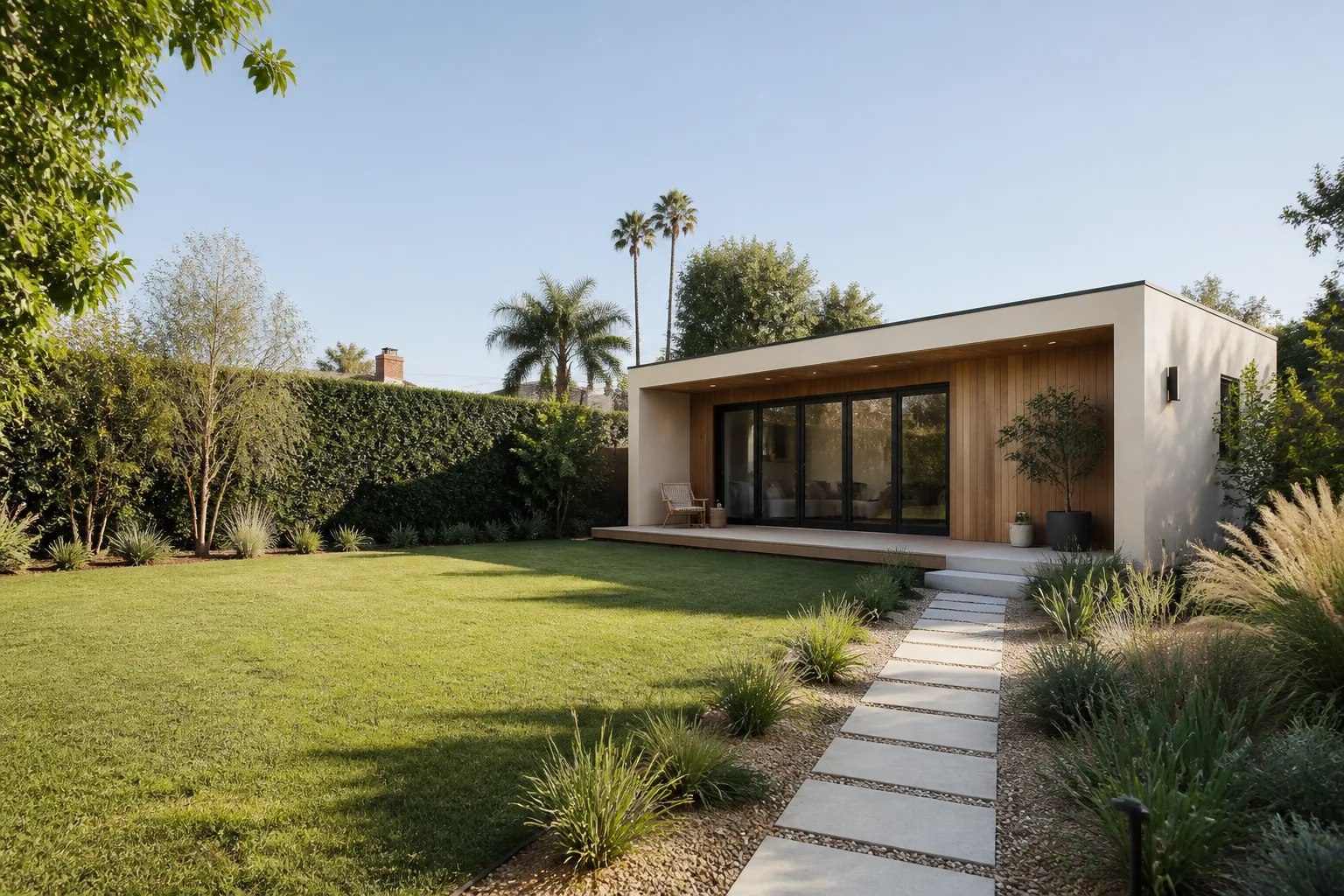
A one-page estimate is a number with a few line items. A legitimate written bid is a document that answers every question you have not thought to ask yet. In Ventura, where ADU projects routinely range from $250,000 to $400,000 depending on whether you choose a garage conversion, a stick-built unit, or a prefab installation, the difference between an estimate and a real bid is the difference between knowing your total cost and discovering new costs every month. See our ADU Cost Breakdown: The Ventura Homeowner’s Reference for 2026 for detailed pricing guidance.
A legitimate written bid covers at minimum:
- Scope of work: The exact work included and, just as important, what is excluded. If the bid does not list exclusions, assume everything not listed is excluded.
- Allowances: Specific dollar amounts assigned to items not yet selected, such as fixtures, tile, or countertops. An allowance of $3,000 for kitchen fixtures sets a real budget. “Allowance: TBD” is not a budget, it is a blank check.
- Change-order process: Written explanation of how changes get priced, approved, and documented. In California, verbal change orders are not enforceable beyond a threshold. A real contractor requires written sign-off before any change happens.
- Payment schedule: Tied to milestones, not dates. You should never pay for work that has not been completed and inspected. More on this in Step 7.
- Guarantee terms: What is covered, for how long, and what the contractor will do if something fails. A written guarantee should survive the final payment and not expire when the crew drives away.
The Kingswell Guarantee operates on exactly these principles. Every Lodgewick ADU Ventura project includes a written price before work begins, a defined arrival window, a clean job site commitment, and a written guarantee on every job. If the work fails within the 365-Day Done Right Promise period, we come back and make it right. That is the standard against which every other bid should be measured.
Step 4: Red Flags Specific to ADU Contractors
ADU projects have their own failure modes, and they differ from general remodeling. Here are the red flags we tell Ventura homeowners to watch for, based on the complaints we hear when homeowners come to us after a bad experience:
- Vague handling of permit pulling: Every ADU in Ventura requires permits. If a contractor says they will “handle it later” or suggests you pull the permit yourself as the owner-builder while they do the work, that is a red flag. Owner-builder permits transfer liability to you and often violate the contractor’s legal obligation to be the responsible party.
- Asking for more than 10% down before work starts: California law caps the initial deposit at 10% of the project total or $1,000, whichever is less. A contractor asking for 20% or 30% down is either unaware of state law or banking on you being unaware of it. Either way, walk away.
- No written answer on who handles inspections: The contractor should name the inspection points, who schedules them, and what happens if an inspection fails. A contractor who treats inspections as an afterthought treats code compliance as an afterthought.
- Pressure to sign before permits are reviewed: Any contractor who asks for a signature before the city has reviewed the plans is asking you to commit to a project that may not be approvable as proposed. In Ventura, setback requirements, parking requirements, and utility connection rules can change the feasibility of an ADU on a specific lot.
- Subcontractor roulette: Ask who will actually be on your property. A licensed contractor who subs the entire job to an unlicensed crew has shifted your risk. The subs’ license and insurance should be verified the same way as the primary contractor’s.
We built our process at Lodgewick ADU Ventura around eliminating these failure points. Background-checked, uniformed technicians work on every job site, so you always know who is on your property, and a live person answers every call, 24 hours a day, seven days a week. If you have a question about your build or your guarantee, you get a human voice, not a voicemail loop.
Step 5: How to Compare Bids $40,000 Apart: The Allowance Audit
Two contractors quote the same Ventura ADU project $40,000 apart. The higher bid is not necessarily padding, and the lower bid is not necessarily a deal. The most common explanation is allowances, and the fastest way to find out is the allowance audit method.
- Line up both bids side by side and highlight every allowance line item. Allowances are the dollar amounts assigned to materials not yet selected: flooring, fixtures, cabinets, countertops, doors, windows, paint.
- Total the allowances on each bid. A bid with $12,000 in total allowances and another with $48,000 in total allowances are not bids for the same project. The $12,000 bid expects you to choose builder-grade finishes. The $48,000 bid expects you to choose mid-range or better.
- Check whether allowance overages are capped or capped out. Bid A might include a $5,000 tile allowance with no cap on overage. Bid B might include the same $5,000 allowance but note that overages beyond 10% require a written change order. Bid B is the more honest document.
- Look for what is missing, not just what is included. The lower bid might omit site preparation, utility connections, dumpster fees, or final cleaning. Those costs do not disappear. They just arrive later as change orders.
The allowance audit takes thirty minutes and usually explains most of the gap between bids. If the gap remains unexplained after the audit, get on the phone with both contractors and ask directly: “Walk me through what creates the $40,000 difference between your bid and the other one I received.” A straight answer is a good sign. Defensiveness is not. Our ADU Builders in Ventura page explains how we structure bids so the allowance math is transparent from the first draft, not discovered in month three of construction.
Step 6: Permits, Inspections, and Ventura-Specific Requirements
Ventura’s coastal climate is kind to structures but hard on the paperwork. Moisture from marine air, the occasional Santa Ana wind event, and the region’s seismic requirements all shape what gets approved and what gets flagged during inspection. Our Seasonal ADU Care for Ventura: Year-Round Homeowner’s Guide covers how these conditions affect your project year-round. A contractor who has built ADUs only inland will hit surprises on a Ventura hillside lot or a property within the coastal zone overlay.
Ventura-specific considerations include:
- Coastal zone overlay: Properties west of certain boundaries fall under California Coastal Commission review, which adds time and restricts what can be built. Your contractor should know whether your lot falls inside this overlay before the first design meeting.
- Slope and drainage regulations: Many Ventura lots, especially in the hills above California Street and toward Foothill Road, have slope conditions that trigger grading permits and drainage studies. These add cost and time. A bid that ignores slope conditions will not survive the permit review.
- Fire-hardening requirements: Ventura’s wildland-urban interface areas require fire-resistant materials, including specific siding and venting. James Hardie fiber cement siding and panels are commonly specified for these zones, and a knowledgeable contractor will account for this in the materials list.
- Utility connection rules: ADUs in Ventura typically connect to existing water and sewer service, but some properties require separate meters or upgraded electric service. Your contractor should identify this early, because upgrading a panel can add $5,000 to $10,000 to the project.
At Lodgewick ADU Ventura, our bids include permit pulling and all inspection scheduling as a named line item. We handle every inspection from the first foundation check to the final sign-off, and we do not consider the job complete until the final inspection is passed and the permit is closed. That means no open permits hanging over your property when it comes time to sell or refinance.
Step 7: Payment Schedules That Protect You
California law limits the deposit to 10% or $1,000, whichever is less, and nothing beyond that should be paid until work is complete and inspected. The payment schedule is where good intentions go to die, so get it in writing before the shovel hits the ground. Here is what a schedule that protects you looks like:
- Deposit: 10% or $1,000 maximum, paid at signing. Anything beyond that is illegal in California, full stop.
- First progress payment: Due when the foundation or site work passes inspection, not when the crew shows up to start digging.
- Second progress payment: Due when the framing passes inspection. Rough electrical, plumbing, and mechanical each get their own inspection-tied payment.
- Third progress payment: Due when drywall and finishes pass the pre-final inspection.
- Final payment: Due only when the final inspection passes and the permit is closed. Collecting final payment before final inspection is a red flag, not a standard practice.
A contractor who asks for payment on a date-based schedule rather than an inspection-based schedule is asking you to carry their cash flow. In our experience with Ventura ADU projects, homeowners who paid by dates rather than milestones were the ones left holding unpaid subcontractor liens. The Kingswell Way states it plainly: say the price before the work, show up in the window given, leave the place cleaner than found, put the guarantee in writing, and come back if it fails. Payment follows the same order: no money for work that has not passed inspection.
Step 8: Working with Prefab ADU Brands in Ventura
Prefab and panelized ADU systems have reshaped what is possible on smaller Ventura lots, and knowing how to evaluate them is part of hiring the right contractor. Brands like Abodu and Cover have made permitting and construction faster by moving much of the build into a factory, while Tuff Shed structures offer a more affordable starting point for basic backyard units. Our team works hands-on with these systems, and that familiarity changes the conversation from “can you build this” to “which system fits your lot, your timeline, and your budget.”
What to know before you choose a prefab route:
- Site preparation is still site preparation. A factory-built ADU needs the same foundation, utility connections, and grading as a stick-built unit. Some are delivered and set in a day, but the site work takes weeks and is where costs get missed.
- The permitting path differs by jurisdiction. Ventura has reviewed and approved certain prefab models under specific conditions, but your contractor still needs to handle the local plan check. A contractor unfamiliar with prefab installations will stumble on the same paperwork.
- The materials in the factory still matter on the lot. James Hardie siding, specified on many of our projects, performs well in Ventura’s marine climate and stands up to the fire-hardening requirements in the hillside zones. The right material on the right lot saves maintenance costs for years.
When a homeowner comes to us after a prefab project stalled, the cause is almost always the same: the contractor knew how to sell the kit but not how to prepare the site or pull the permit. Our Garage Conversion Contractor in Ventura page explains how garage conversions compare to prefab and stick-built ADUs in cost, timeline, and complexity.
Common Mistakes to Avoid
- Choosing the lowest bid without auditing allowances. The cheapest bid is usually the cheapest because it omits $40,000 in finish costs. Audit the allowances before you compare prices.
- Skipping the CSLB license check. An expired or suspended license voids the contractor’s bond coverage and leaves you with no recourse if the project goes sideways. This takes three minutes and saves six figures.
- Signing a one-page estimate instead of a written bid. If the document does not list exclusions, change-order procedures, and guarantee terms, you do not have an agreement. You have a starting negotiation.
- Paying by dates instead of milestones. Money should follow inspected work, not the calendar. A contractor paid ahead of schedule has no incentive to finish.
- Ignoring open permits on previous projects. A contractor with a trail of unclosed permits in Ventura is describing a pattern, not an exception. Check the permit history before you sign.
- Assuming the subcontractors are covered. The primary contractor’s insurance does not automatically extend to subs. Verify coverage for anyone who will step onto your property.
- Overlooking Ventura’s coastal zone and fire-hardening rules. A contractor unfamiliar with local overlays will submit plans that get rejected or build materials that fail inspection. Local experience is not a nice-to-have; it is a requirement.
When to Call a Professional
If you are planning an ADU in Ventura and any of these conditions apply, get an expert involved before you sign anything: your lot has slope or drainage issues, your property falls inside the coastal zone overlay, you are converting an attached garage and need structural work, or you have received two bids that differ by more than 15% and want to understand why. A trained professional can review the site, identify the Ventura-specific requirements, and structure the project so your price does not change at the door. Lodgewick ADU Ventura offers free estimates in Ventura. Call (831) 230-7250 to schedule one. A live person answers, and you will get a written price before any work begins.
Frequently Asked Questions
A garage conversion ADU in Ventura typically runs $150,000 to $250,000, while a detached stick-built ADU ranges from $250,000 to $400,000, and prefab systems from Abodu or Cover generally land between $200,000 and $350,000 including site work. These ranges include permits, utility connections, and standard finishes. Call (831) 230-7250 for an exact quote, and the estimate is free.
A typical ADU project in Ventura takes 9 to 14 months from design to final inspection, with permitting alone accounting for 2 to 4 months depending on the coastal zone overlay and plan-check queue. Prefab systems can shave 2 to 3 months off the construction phase. The timeline should be written into your bid, and changes should be communicated in writing.
Yes, every ADU in Ventura requires a building permit, and your contractor should pull it as the responsible party. Some properties also require grading permits, coastal development permits, or fire-hardening compliance reviews. Learn more in our guide to ADU Permits, Codes & Inspections in CA: What You Need to Know. A contractor who suggests skipping permits is setting you up for fines, forced removal, and denied insurance claims.
It should not, if the bid is written correctly. Allowance overages and change orders are the only legitimate reasons for price adjustments, and both require your written approval. The Kingswell Guarantee states it in writing: a written price before work begins, no price changes at the door.
California law caps the initial deposit at 10% of the project total or $1,000, whichever is less. Any contractor requesting more is either unaware of state law or counting on you being unaware. Do not pay a larger deposit under any circumstances.
Ask the contractor for permit numbers from previous Ventura projects, then verify them through the Ventura County Building and Safety division. Look for final inspections and closed permits. Open permits on past projects are a warning sign that unresolved issues trail this contractor. Call (831) 230-7250 for a free consultation, and we will show you our own permit history as part of the first conversation.
The Bottom Line
Hiring an ADU contractor in Ventura is a process where the wrong first move compounds into a stalled project, a lien, or both. Verify the license on CSLB.ca.gov, request the four documents before the first meeting, demand a written bid with real allowance numbers and an inspection-based payment schedule, and audit the allowances before comparing prices. The contractor who resists any of these steps is revealing how the rest of the project will go. The Kingswell Guarantee at Lodgewick ADU Ventura puts every commitment in writing before the first nail is driven: written price first, real arrival window, clean job site, written guarantee on every project, and a free return visit if the work fails within the 365-Day Done Right Promise period. Call (831) 230-7250 to schedule your free estimate in Ventura.
Written by Russ Delmar, Owner at Lodgewick ADU Ventura, serving Ventura since 2010.