James Hardie Junior ADU Conversion: The Ventura Owner’s Guide
If you have a James Hardie panel or siding product on a junior ADU (JADU) conversion in Ventura and a section of it has failed, cracked, warped, or pulled away from the structure, the fix is matching the damaged board or trim to the rest of the Hardie system and replacing it properly with the same flashing details. A typical James Hardie siding repair on a Ventura JADU runs between $850 and $2,400 installed depending on the number of boards, access, and whether trim or soffit is involved. Most homeowners find the problem after a wet winter: a corner board swells or a bottom course near the foundation starts to delaminate, especially on older garage conversions where water has been sitting against the sill for years without anyone noticing.
The longest wait is usually not labor. It’s finding a contractor who will actually show up to do a small repair on a structure they didn’t build. That’s the real reason a torn corner of HardiePlank on a JADU in Midtown Ventura sits open for nine months while the owner stares at it every time they walk from the main house to the unit.
Which James Hardie Models This Applies To
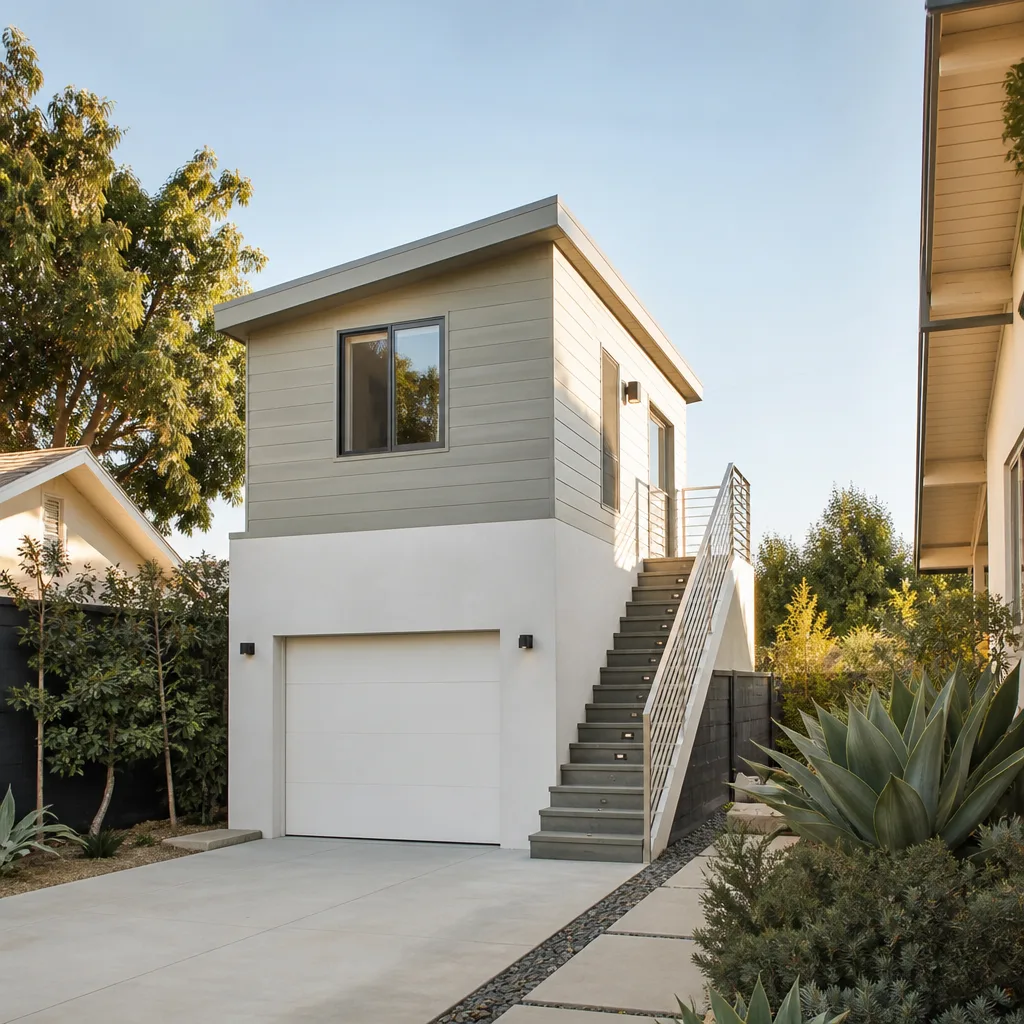
James Hardie siding is not one product. On junior ADU conversions in Ventura we typically see three lines: HardiePlank lap siding in 5/16″ and 7/16″ thicknesses, HardiePanel vertical siding in 4×8 or 4×10 sheets, and HardieTrim boards in smooth or woodgrain finish. Each one takes different fasteners, different clearance gaps, and different flashing. The version on your JADU matters a lot more than most people think.
Here’s the gotcha: HardiePlank changed its dimensional profile slightly over the years. A 7/16″ board from 2010 is not interchangeable with a current-production 7/16″ board when it comes to butt joints visible to the eye. The profile of the shiplap edge is subtly different. If you’re replacing three or four boards in the middle of a wall on a detached JADU off Ventura Avenue, that mismatch shows. In those cases we order the matching current lot, adjust the reveal, or replace the full field of that wall so the patch doesn’t announce itself. It costs a little more upfront and looks right for the next 20 years. As an independent Ventura contractor, we’re not affiliated with James Hardie Corporation. We just work with their materials constantly and know where the compatibility pitfalls are.
For homeowners set on OEM parts, we source direct through the same regional distributors we order from for new JADU builds and garage conversions in Ventura. For aftermarket equivalents, we usually talk people out of them for Hardie specifically. Fiber cement is a recipe-based product, not a machined commodity. A knockoff cement board does not carry Hardie’s 30-year limited warranty on the board itself, and the texture and edge profile rarely match after a few years of coastal sun. The place where aftermarket makes sense is corner trim and window band boards, where primed cedar or PVC trim board from suppliers like Versatex or LP SmartSide actually looks better than painted HardieTrim after exposure, especially within a few hundred yards of the Ventura coast where marine air chews through factory primer.
Signs Your James Hardie Junior ADU Conversion Is Failing
- Bottom course swelling or crumbling at the edges. Water is wicking up from grade contact or sprinkler overspray. Hardie requires 6″ clearance from soil and roofing felt behind the bottom edge. Most JADUs in Ventura break one or both rules, and the bottom boards are the first to go.
- Vertical hairline cracks running from window corners. HardiePanel, especially the older 5/16″ sheet stock, doesn’t flex. When a wall settles or a window header moves even a quarter inch, the sheet cracks instead of bending. We see this constantly on the west-facing wall of garage conversions where afternoon sun in the 40s and 50s Fahrenheit dries the framing at a different rate than the cement board sheet.
- Paint peeling in sheets but only at the butt joints. That’s not paint failure. That’s water getting behind the joint flashing or the builder using the wrong caulk. Hardie requires a 1/8″ gap at end joints and flashing or caulk rated for fiber cement. When the wrong sealant is used, the joint fails from the inside and the paint goes with it.
- Nails backing out. Hardie should be fastener-flush. A nail that pops means the framing behind it is moving or has moisture damage. On a JADU, that often points to a porch beam connection or a gutter overflow that has been soaking the plate line.
- Mold or dark streaks in a straight vertical pattern. That’s a failed kickout flashing at a roof-wall intersection. Every gutter that dumps water against a Hardie wall will stain and then delaminate the board. It reads as a siding problem, but it’s a flashing problem. Fixing the board without fixing the flashing means doing the job again in 18 months.
Replacement Cost & What’s Included
For a James Hardie board replacement on a Ventura JADU, the installed cost breaks down like this: single board replacement with paint match runs $850 to $1,200; a three-to-five board section repair runs $1,400 to $1,900; a full elevation re-side of a 10×20 JADU wall runs $2,200 to $2,800. The range comes from access (second-story JADUs above garages cost more), whether the existing boards were installed with nails or screws (screws are slower to pull), and whether we have to repair tar paper or housewrap behind the board.
Every number we give you in Ventura is a written number before work starts. The price includes removing the damaged boards, checking the flashing and sheathing behind them, installing the matching James Hardie product with correct clearance gaps and fasteners, and color-matched painting on the repair area. The 365-Day Done Right Promise covers this work in writing. If a repaired board fails within the year, we come back and fix it at no charge. That’s not an ambition, it’s our standard work order.
DIY or Call Us?
You can absolutely look at the damage and decide whether it’s one board or a wall. You can check for sprinkler heads pointing at the wall, clogged gutters, and missing caulk. Fiber cement is not inherently dangerous to handle the way a tensioned spring or an energized electrical panel is, so checking and documenting is low risk. What goes wrong with DIY Hardie repair is almost always the hidden layer: the flashed joint, the clearance gap, the grade-contact rule, the moisture problem behind the board.
What we stock in our Ventura service vehicles: HardiePlank in both thicknesses, HardiePanel sheet goods, HardieTrim in the most common profiles, flashing stock, fiber cement rated sealant, fasteners, and paint matching gear. If your board is on a second-story JADU or involves the wall plate at a roof line, call us at (831) 230-7250 before you get on a ladder. Waiting a day for a proper repair costs less than a fall or a second repair a year from now. Russ Delmar will tell you straight whether this is a one-board job or a wall that needs a different plan.
FAQs
James Hardie siding itself carries a 30-year limited warranty on the board, but in Ventura the realistic lifespan before you’re replacing pieces is 20 to 25 years, faster if the original install skipped the 6″ ground clearance or used the wrong flashing at roof intersections. The board doesn’t rot like wood; it deteriorates from water intrusion at seams and edges.
You can temporarily seal a hairline crack with an elastomeric caulk and paint, but on a JADU in Ventura that repair rarely survives a full wet season. The correct fix is board replacement. Sealing a crack in fiber cement is a band-aid over whatever caused the crack, and the crack usually re-appears wider the following spring.
Most single-board and small-section repairs are completed in half a day on site. Full wall re-sides on a small JADU take one to two days. Paint matching adds an hour because the patch color is matched to the weathered adjacent boards, not the original spec, unless we’re re-painting the whole wall.
Our Ventura crews carry HardiePlank lap siding in the most common reveals, HardiePanel, HardieTrim boards, flashing, and fiber-cement-rated fasteners and sealant on the service vehicle. If your JADU uses a discontinued profile we order direct from the distributor and have it within a few days. We also work on Abodu, Cover, and Dvele prefab ADU panels when the skin or siding needs work.
If you have a James Hardie-equipped junior ADU in Ventura and a board is cracked, swollen at the joint, or pulling from the wall, call (831) 230-7250 for a free estimate. Tell us what the space is doing for you, and we’ll tell you what it costs to make the outside of it as solid as the inside. The Kingswell Guarantee means a written price before we start, a real arrival window, and a clean job site when we leave. That’s how we handle every JADU repair in Ventura.
Written by Russ Delmar, Owner, Lodgewick ADU Ventura at Lodgewick ADU Ventura, serving Ventura and nearby areas.